
'/%3e%3cdefs%3e%3clinearGradient%20id='prefix__paint0_linear_4737_37157'%20x1='3.018'%20y1='23.6'%20x2='44.925'%20y2='24.977'%20gradientUnits='userSpaceOnUse'%3e%3cstop%20stop-color='%231CB7FF'/%3e%3cstop%20offset='.502'%20stop-color='%232FF58B'/%3e%3c/linearGradient%3e%3c/defs%3e%3c/svg%3e)


Xabi Alonso’s Chelsea Are Exactly Where They Need To BE
Sep 18 2026 23:18 · By onefootball.com · 4 Reads


CHE
Chelsea The Blues
Analysis Opinion
By September 18, 2026 · 7 min read
Seven points out of a possible 12 in the first four matches of the league. Into the fourth round of the Carabao Cup. Chelsea’s frontline seems to be firing on all cylinders, yet fans are still wondering whether the Blues are on the right track in light of the defensive atrocities committed. In this article, we argue why no one should be surprised by Chelsea’s start and why they are exactly where they should be.
Chelsea Promising And Frustrating START
Seven points from four league games. A place in the fourth round of the Carabao Cup. A frontline firing on all cylinders. Yet Chelsea fans are still asking whether the Blues are on the right track—and the answer may be simpler than they think.
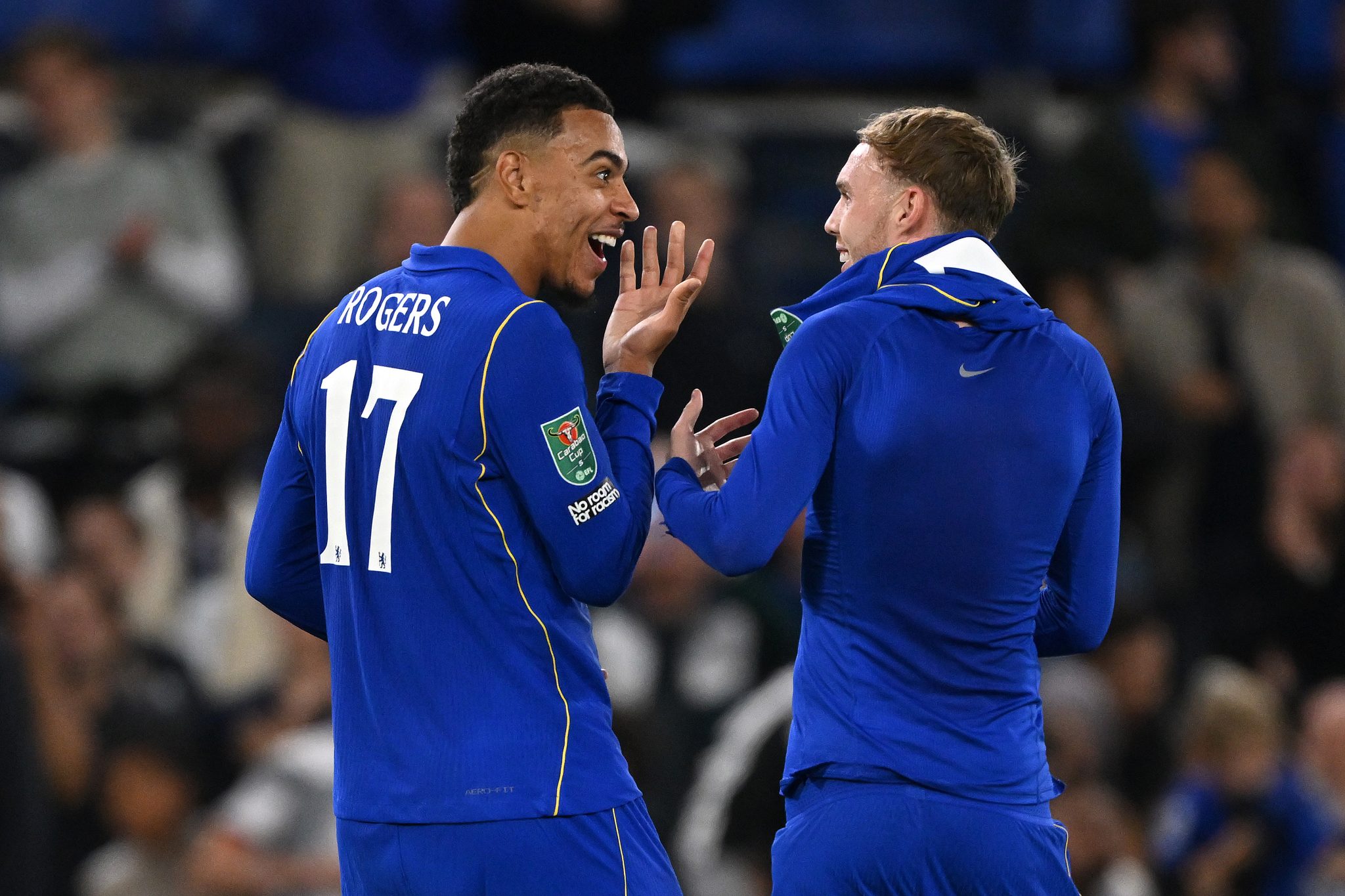
LONDON, ENGLAND – SEPTEMBER 09: Morgan Rogers and Cole Palmer of Chelsea share a joke at the end of the Carabao Cup Third Round match between Chelsea and Leeds United at Stamford Bridge on September 09, 2026 in London, England. (Photo by Mike Hewitt/Getty Images)
Chelsea’s season was never going to be straightforward, and it should not be treated as such. Two away derbies—one against the obvious Premier League title contenders—plus fixtures against stubborn, Europe-chasing mid-table sides in Fulham and Brighton, and a meeting with this season’s fairytale story, Hull City.
From a possible 12 points, the West Londoners collected seven, dropping points against Hull and losing to Arsenal. They dispatched Luton with ease and Leeds United with considerably less. Across six matches, the blueprint has been glaringly obvious: brilliant going forward, fragile at the back and in midfield.
The results themselves are satisfactory—Hull City perhaps the only genuine blip in what is a fairly ordinary and expected record. The performances, however, have left supporters uneasy. Many have already begun questioning Xabi Alonso’s management, his structure, his player selections, and virtually everything else within reach. After a long period of drift and disappointment, the skepticism is understandable. But it is also premature.
Is it a coaching PROBLEM?
The first question worth asking: is Chelsea’s defense really that bad, or is the manager failing to set them up properly?
A backline of Colwill, Fofana, Lacroix, and Acheampong should be defending far better than it has in recent matches. The more likely culprit is the midfield—and its inability to keep possession—which is leaving the defense exposed.
Alonso can certainly do better. There is no question about that. His team must learn to sustain settled possession and control games both with and without the ball. When Chelsea lose the ball, their structure leaves much to be desired. Matches descend into transition battles, with the Blues attacking directly and vertically—a approach that inevitably opens gaps between the lines. Any manager will tell you that attacking at such a frantic pace leaves spaces behind.
The pressing is disjointed. There is a visible lack of coherence between the lines and in the marking assignments. Look at all of this, and the temptation is to blame Alonso entirely—or, in the binary way humans tend to think, to credit him with none of the attacking prowess and attribute it all to the magic of the front three.
Chelsea Are EXACTLY WHERE THEY NEED TO BE
Alonso can and must improve. But here is the catch: he is exactly where he needs to be.
In modern football, nothing comes easily. Managers need the precious commodity of time. Until they have it, expect a team that is lacking in many aspects of the game.
Many fans will point back to Thomas Tuchel and how he fixed Chelsea’s structure within two days of his appointment. Yet they forget that this structure came at the expense of the team’s attacking prowess. Chelsea became adept at winning 1-0, and Tuchel drilled that into the side.
Ask those same fans what happened once physical teams scored and sat back in a low block. Ask them how far Chelsea would have gone in the Champions League without that victory over Manchester City—and without Bale’s brilliance against Leicester.
Even Maresca, a man obsessed with control, played a transition game at the start of his reign. Once he slowed the pace to protect his defense, fans grew disgruntled with his boring football.
Think of the best managers of the post-Sir Alex Ferguson Premier League era, and three names come to mind: Pep Guardiola, Jürgen Klopp, and Mikel Arteta. Each endured, to varying degrees, this preliminary phase of vulnerability.
Guardiola suffered through a season of high-scoring games he dominated but could not win because his team could not close matches out—before forging a dynasty. Arteta needed four years to rebuild Arsenal.
Look at Klopp’s early seasons, before Alisson and Van Dijk arrived, and the goals his team conceded, goals that schoolchildren would be embarrassed to give up.
Each of these managers was given the time and patience to rebuild. Players need time to build relationships, understand one another, and absorb the manager’s system. Managers need time to drill settled possession patterns and teach their teams how to handle in-game situations. The ability to close out games even when playing poorly is learned only through experience. These are the growing pains supporters must live with.
None of these results or performances should be shocking. This is what is expected from a team in Chelsea’s position. Many fans were bewildered by the club’s transfer activity, but they overlooked the current state of the squad.
The Midfield Problem & Individual Performances
Yet blaming the gaffer alone would be dishonest. Structure allows players to be the best versions of themselves—but no structure excuses basic individual errors at this level.
Take Jorrel Hato, a Premier League and international defender, misjudging an aerial ball inside his own penalty box for Hull City’s first goal. That is not a structural failing. That is a player failing to do the fundamentals of his job. Alonso can organize, drill, and prepare his backline, but he cannot head the ball for them.
This distinction matters. When supporters demand answers, the finger should not point in only one direction. Players must be re-evaluated on their own merits, not merely as products of a system. Some of Chelsea’s defensive concessions this season have been collective breakdowns. Others have been simple, inexcusable lapses that no amount of coaching can prevent.
Then there is the glaring hole in midfield—partly due to injuries, partly due to poor planning.
This is a team missing its star midfielder, who, as a result of that poor planning, happens to be the only one capable of walking into any top Premier League side. The remaining midfield options are a makeshift right-back, a left-back-turned-midfielder still finding his feet at the club, an injury-prone option who has never played 90 minutes of Premier League football in his fourth season at Stamford Bridge, and a 36-year-old brought in for experience, who then injured his hand in a reckless goal celebration at the World Cup.
When your midfield is this short-handed—and unready in any event—one must ask whether it is affecting the defensive coverage and the team’s ability to keep possession.
The Verdict
Alonso’s offensive work is clear. Chelsea’s attack is capable of matching any opponent, and that is not down to quality alone. The gaps in defense and midfield, however, are equally clear—and will remain until the manager has enough time to iron out the mistakes. The goal is still to finish in Champions League places, and the fans should never lose sight of this target.
The return of Caicedo and Palestra will help paper over a few cracks. But make no mistake: this team is where it exactly needs to be, this process will take time, and fans must learn to live with it.